Introduction
Because of the importance of the nitrogen (N) and carbon (C)
cycle in biological systems, the emission of gaseous reaction
products such as methane (CH4) and nitrous oxide (N2O) during
these biochemical processes is unavoidable. However, human
activities like agriculture have led to a higher C- and N-input
and thus to an increase in the emission of CH4 and N2O and,
ultimately, to the intensification of global warming. The global
warming potential (GWP) of CH4 and N2O is estimated to be 20 times
CH4 (IPCC, 1992) or even 300 times (N2O) (Olivier et al., 1998) the
GWP of carbon dioxide (CO2) (in relation to the mass and a time
horizon of 100 years). Furthermore, N2O emissions contribute to the
depletion of ozone in the stratosphere, which is caused by the
stratospheric conversion of N2O to NO (Olivier et al., 1998).
According to current estimates, the global emission of CH4 and N2O
amounts to 535 (Houghton et al., 1996) and 17.7 MT
(Kroeze et al., 1999; 1 MT = Tg = 1012 g) respectively. Subak et al (1993)
estimated that 103 MT of the man-induced CH4 emissions originate
from livestock production. The emission of N2O from anthropogenic
sources amounts to ca. 8.0 MT per year. Of these, ca. 6.2 MT are attributed to
livestock production (Kroeze et al., 1999). Olivier et al. (1998) emphasise that
fertiliser consumption and animal excreta are equally important as the largest
contributors to agricultural N2O emissions. Many authors mention
that the greatest uncertainties in the greenhouse gas emission data
(e.g. IPCC, 1992; Subak et al, 1993; Houghton et al., 1995) are mainly
caused by insufficient knowledge about the source-specific emission factors.
Therefor the criteria for scientific investigations and the collection of
emission data will be discussed at first because of the significant difference
between "data" and "reliable data". Afterwards the results of a literature
survey on the emission levels of N2O and CH4
from different animal species and husbandry systems are presented. The emission
levels listed below are mainly the result of German and Dutch investigations.
Since the marginal parameters indicated in the literature were not always
sufficient for the use of one common unit for all emission factors (e.g.
kg emission per livestock unit (LU) and day), different reference quantities
are employed to describe some of these factors.
Requirements for Measurement Methods and Instruments for the Quantification of
Emission Levels
The emission of gases and odour from livestock facilities exhibits a wide
range of diurnal and seasonal variation (Keck, 1997, Hartung et al., 1998).
Minimum requirements for the measurement of emissions were formulated by
Hartung (1995) and Jungbluth and Büscher (1996):
Continuous measurement of ventilation rates and gas concentrations,
Long-term experiments for the description of diurnal and seasonal effects
Amon et al. (1998) call for continuous measurements with highly precise instruments
which must be repeated in different seasons. Only measurements carried out continuously
over several seasons provide reliable data for the calculation of the emissions caused by
different housing systems or production processes (Table 1). Setting such high requirements
also means that about 80% of the publications do not provide a suitable basis for the
calculation of emission levels.
Very expensive measuring instruments, which often cannot be purchased
two- or threefold, are one essential prerequisite for the postulated
requirements to be met. This leads to the dilemma that, under practical
conditions, measurements with highly accurate instruments can usually be
taken only at a few selected locations. Therefore, the number of measurements
from the same farm or production system is often very low.
Table 1: Requirements governing the methods and the equipment for the quantification of greenhouse gases and gaseous pollutants from agriculture (Amon et al., 1998).
Literature Survey on Greenhouse Gas Emissions
With regard to the literature data concerning greenhouse gas emissions from
livestock, a distinction can be made between measurements at the animal level
and measurements at the system level. Data at the animal level are generally
gained in respiration chamber experiments, whereas system level data are mainly
collected during emission measurements in animal facilities.
animal level
As regards greenhouse gas emissions from animals (i.e. their digestive system),
only a few data are available, which are usually limited to CH4. Kroeze (1998)
reports that the percentage of N2O released by the animals is still unknown and
can probably be neglected, at least at the national level. Data on CH4 emissions
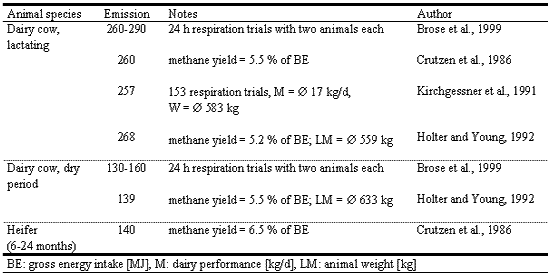
from cattle are summarised in Table 2. These data are mainly the result of feeding
trials in respiratory chambers. The CH4 emitted originates from breath and flatus.
Table 2: CH4 emissions (g LU-1 d-1) from dairy cows and heifers (animal level).
The data in Table 2 show that cattle produce substantial amounts of CH4,
which vary depending on the lactation stage and the age. The variation in the formation of
CH4 reported by the authors is most likely caused by differences
in diet, the animal weight and dairy performance. The quantity of CH4
emitted ranges between 5.2 and 6.5% of the Gross Energy (GE) intake (Table 2)
(Pelchen et al., 1998). Corre and Oenema (1998), however,
reported that the amount of CH4 produced by cattle roughly equals
10% of the digestible feed intake.
With monogastric animals, like pigs and poultry, microbial
fermentation only occurs in the large intestine, with an estimated
CH4 production of less than 1% of the digestible feed intake
(Corre and Oenema, 1998) or approximately 0.6% of the gross energy
intake (Crutzen et al., 1986).
System level
Cattle
Table 3 summarises the measured CH4 emissions from housing systems for cattle.
The CH4 emissions originate from both the animals and the excrement stored
indoors.
Table 3: CH4 emission (g LU-1 d-1) from cattle housing systems (system level).
The data in Table 3 illustrate that CH4 emissions from cattle houses
range from between 120 and 390 g d-1LU-1, with somewhat higher values for
dairy cows in loose housing systems (cubicle houses). This range of data is
comparable with the range of CH4 emissions used as normative values for dairy
cattle in the Netherlands (63-102 kg per year per animal, corresponding to
173-279 g d-1 per animal) (Van Amstel et al., 1993). The highest CH4 emissions
occur during feeding and rumination (Brose et al., 1999). The emission levels
are mainly influenced by the animal weight, the diet, and the milk yield. Furthermore,
details of the housing system design (e.g. air conduction, type of flooring, type and
dimensions of manure removal and storage of excrement) play a role. The large number
of influencing factors shows that realistic normative values for the calculation of
CH4 emissions (e.g. in national studies or emission inventories) should be differentiated
with regard to housing systems, besides the already stated need for differentiation
according to the age of the animals, the type of feed, the diet, the feeding level
and the lactation stage.
A comparison of the data listed in Table 2 (animal level) and Table 3 (system level)
shows that CH4 emitted from the respiratory system of the cows accounts for the largest
part of the CH4 emissions from cow houses. This is confirmed by data reported by Kinsman
et al. (1995), who attributes less than 10% (21 g d-1 LU-1) of the total CH4 emission
from a tying stall for dairy cows to the manure stored indoors. However, it is very
difficult to measure the percentage of the CH4 emission caused by manure and animals.
Data about the specific CH4 production from animal excreta (1.3 kg CH4 per tonne of
cattle excreta; Van Amstel et al., 1993) and data about the volumes of slurry produced
in cow houses (16 tonnes of excreta per year; Van Eerdt, 1998) lead to the assumption
that the CH4 production from manure stored in dairy cow houses would amount to
approximately 21 kg per year per animal (57 g d-1 per animal if the animals
spend 365 days per year indoor).
This is about 20% of the CH4 produced during the entire fermentation process
and substantially more than the figure reported by Kinsman et al. (1995).
This discrepancy clearly shows that there is a need for additional, more
specific data for CH4 emission from cattle stalls.
As regards N2O emissions from cattle housing systems, only very few data
exist, mainly because the accurate measurement of ventilation rates in
naturally ventilated houses is difficult, time consuming, and requires
extensive equipment. Additionally the measurement of usually very low
N2O concentrations cause considerable difficulties (detection limit,
resolution and accuracy of continuously measuring gas analysers). The
available data are summarised in Table 4:
Table 4: N2O emission (g LU-1 d-1) from cattle housing systems.
Amon et al. (1998) reported no difference in N2O emission between
tethered housing with solid and liquid manure. At higher temperatures,
an increase in N2O emissions from deep litter systems was recorded. Only
deep litter systems with straw seem to produce significant quantities of
N2O, which is most likely caused by nitrification and denitrification in
the litter bed. Slurry systems, however, produce no or only little N2O
because slurry generally contains neither nitrate nor nitrite which
could be degraded through denitrification in anaerobic areas (Hüther, 1999).
Sneath et al. (1997) also reported very low N2O emissions at the detection
threshold of the measuring instrument.
Pigs
Results from studies on CH4 and N2O emissions from different pig housing
systems are given in (Table 5). CH4 is emitted by all pig housing systems,
but the data show great variation mainly caused by the different animal species
and housing systems. CH4 emissions from fattening pigs range between 1.5 and 11.1
kg per animal place per year, whereas emissions of 21.1 and 3.9 kg per animal place
per year were reported for sows and weaners, respectively. Excrement temporarily
stored indoors is the main source of CH4 emissions. The quantity of CH4 emitted
by the animal itself should not be neglected because it may amount to up to 8 l
of CH4 per pig and per day (Ahlgrimm and Bredford, 1998). The amount of CH4
emitted from stalls for fattening pigs is influenced by the diet (digestibility),
the daily weight increase of the animals, the temperature, and the kind of housing
system (Ahlgrimm and Bredford, 1998; Hüther, 1999). Hahne et al. (1999) found
higher CH4 emissions in autumn and winter when the air exchange rates are lower.
They suggested that the CH4 production might be influenced by the availability
of oxygen over the emitting surfaces.
Similar to deep litter stalls for cattle, significant N2O emissions from pig
husbandry exclusively originate from deep litter- or compost systems. The
variation in the N2O emissions is mainly caused by the kind of housing system
(no data available for sows and weaners). Fattening pigs kept on partly or
fully slatted floor (slurry-systems) emit very little N2O (0.02-0.31 kg per
animal place per year), whereas higher emissions (1.09 - 3.73 kg per animal
place per year) were reported for fatteners in deep litter and compost systems
(Groenestein and Van Faassen, 1996). At present, no reliable data are available
for sows and rearing pigs.
Poultry
The CH4 and N2O emissions from housing systems for laying hens (Table 6) vary greatly and
must be judged very critically because the measured concentrations were very low
(sometimes only slightly above the ambient concentration of N2O). In general,
floor husbandry systems for laying hens seem to emit more N2O than battery
cages or aviary systems, which is mainly caused by the presence of material
(e.g. wood shavings, straw, litter) on the floor. Reliable CH4 and N2O emission
data for other kinds of poultry such as broilers, turkeys, ducks etc. and for
housing systems with natural ventilation (e.g. Louisiana stalls) are not yet available.
Gas emission values for poultry are low when compared with emissions
from cattle and pigs, which is mainly caused by the considerably lower
body weight of the hens. If the body weight of one laying hen is assumed
to be 2.5 kg, one LU would correspond to approximately 200 hens, and the
N2O emission established by Sneath et al. (1996) would amount to ca. 0.042
kg per animal place and per year.
Table 5: CH4 and N2O emissions (kg per animal place per year) from pig housing systems
Table 6: CH4 and N2O emissions (kg per animal place per year) from poultry facilities.
Concluding Remarks
The formation and emission of CH4 and N2O from sources in animal husbandry
are a very complex phenomenon. Both gases are produced during the biological
degradation of nutrients in animal excreta and, to some extent, their formation
is influenced by the same parameters (e.g. temperature, substrate availability).
Besides these similarities, there are also significant differences, mainly with
regard to the conditions under which the gases are produced. CH4 is mainly a primary
product of anaerobic processes, whereas N2O as a secondary reaction product is formed
in process chains where nitrification and/or denitrification occur.
Only very few precise emission rates of CH4 and N2O from different animal
husbandry systems are available. Some of the data presented in this paper
show considerable variation, which must mainly be attributed to the large
number of factors that influence the amount of CH4 and N2O emissions.
Without repeating all the results in detail, it is possible to say that:
the measuring method and -equipment must meet certain minimum requirements
with regard to accuracy, measuring periods, and the repetition of measurements;
the comparability of the available data is limited due to different measuring
methods and experimental sites;
CH4 emissions from cattle husbandry are relatively well known,
while for other animal species and production systems only very few data are
available, which can only be used to a very limited extent;
N2O emissions are very difficult to quantify. Therefore, no reliable
data are available for emission rates from virtually all animal species and production systems;
especially data for new housing systems and/or natural ventilation systems are missing.
The standard emission factors which are currently used for
national and international emission budget calculations may
have to be adapted to future insights and newly found cause-effect
relations. With increasing knowledge about the emission rates from
different sources, the necessity for a more detailed consideration
of the emission factors and the cause-effect relations that
characterise them will gain in importance.
References
The references are available from the author.
|