Introduction
There is general consensus that the emission of ammonia (NH3)
from anthropogenic sources like agriculture has to be reduced
to comply with nitrogen (N) deposition levels in environmental
protection policies, with a focus to maintain future biodiversity
(Erisman et al., 1998). In The Netherlands, with the greatest NH3
emission per km2 in Europe (Asman, 1995), NH3 contributes about 46%
to the deposition of potential acid (Erisman & Draayers, 1995).
Critical loads of acid deposition on natural ecosystems are exceeded
in many European countries nowadays. As a consequence, eutrophication
occurs. This has three main effects. First, the composition of the
vegetation changes towards N loving species, that supersede the more
rare plant species that are typical for ecosystems that are poor with N.
Secondly, it leads to nutrient imbalances in the soil, which increases
the risk of damage to the vegetation by drought, storms, frost, diseases
and plagues (Grennfelt & Thörnelöf, 1992; Bobbink et al., 1995). Thirdly,
leaching to the ground water of the surplus N in the form of nitrate
occurs (Heij & Schneider, 1991). Deposition of NH3 to the soil can also
lead to soil acidification, which is related to the rate of nitrification
in the soil. Under the influence of oxygen, nitrifying bacteria transform
NH3 into nitrate, water and acid (H+).
Within global agriculture, cattle husbandry is the biggest single source
of anthropogenic NH3 emission (Bouwman et al., 1997). Its NH3 originates
mainly from application of the excreta on the field (grassland, arable land)
and housing systems, and to a lesser extent from outdoor stores, grazing and
crop residues. On a farm scale, around 25% of the N excreted in the cattle
urine and faeces or 20% of the N input is lost as NH3 (Aarts, 2000).
Measures to reduce NH3 emission from excreta application are used more
and more in nowadays dairy farming, either to prevent the loss of
fertiliser N value of the excreta or to comply with NH3 abatement
legislation (e.g. in the Netherlands). However, future environmental
constraints require the development of farming systems with an nutrient
balance, i.e. with minimal losses of nutrients (N, phosphorus, potassium)
to the environment. All stages of the dairy farming process have to be
taken into account to achieve this.
Nitrogen put in agricultural cycles is partly fixed in animal products and
crops. The remainder is lost to the environment mainly as nitrate (NO3-)
and ammonia (NH3), assuming no accumulation in the soil on the longer term
(Aarts, 2000). Also, volatile losses by nitrogen gas (N2) and nitrous oxide
(N2O) will occur. The amount of ammonia (NH3) emitted to the atmosphere on a
global scale is estimated at 54 million tons per year (range: 23-88), of which
22 million tons (range: 20-61) originates from animal husbandry.
The contribution of cattle husbandry amounts 13 million tons of N per year
(Bouwman et al., 1997; Olivier et al., 1998).
Processes, factors and sources
For poultry excreta, urea is produced from the microbiological decomposition
of uric acid. This process is relatively slow (within days) compared to urea
decomposition (within hours). Most important factors are temperature and water
activity. The urea is further converted to NH3. Also in dairy cow and pig houses
and on grazed pastures, NH3 originates from urea that is converted by the enzyme urease:
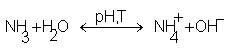
Following the urea decomposition, with the urease activity as the most important
factor, NH3 is in equilibrium with ionised ammonium. This aquatic equilibrium is
temperature and pH dependent:
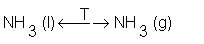
The unionised NH3 in the aquatic ('l') environment
(e.g. slurry or urine pools upon floors) is in equilibrium
with gaseous ('g') NH3 at the liquid/air boundary according to
temperature dependent Henry's law of distribution:
The gaseous NH3 at the boundary ('bound') may now volatilise to the
ambient air. This volatilisation process, convective mass transfer,
depends on the temperature and the air velocity above the liquid:
Moreover, the ambient air has impact, because the volatilisation is
hindered by high NH3 concentrations in the air. The processes mentioned
above are particularly valid for the animal house. During indoor and
outdoor storage of excreta, non-urea N compounds are decomposed to NH3
(Patni & Jui, 1991). Emission levels from outdoor stores greatly depend
on the type of excreta, the climatic conditions (temperature, air velocity),
the duration of storage and the presence of a cover on the slurry basin (Oleson
and Sommer, 1993). The magnitude of the NH3 emission depends on the application
technique, the type and composition of the excreta, and the actual soil and
climatic conditions (e.g. Van de Molen et al., 1990).
Emission levels and possibilities for emission reduction
Many investigations have been conducted to determine emission levels for the sources
of NH3 in agriculture. This paper presents an executive summary of the results
mostly from Dutch research. Although of great importance, no attention is paid
to measurement techniques that were and can be used to determine levels for NH3 emissions.
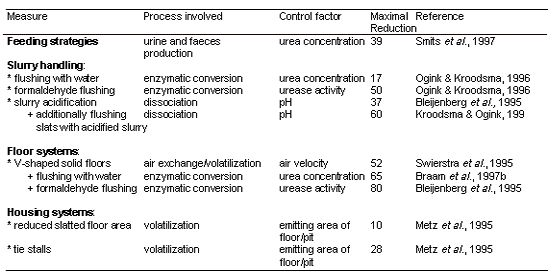
Table 1. Overview of the working principle of emission reducing measures and reduction of the NH3 emission for dairy cow houses reported in literature (in % compared to slatted floors).
This data indicate that technical measures aiming at a reduced pH
(acidification) and exclusion of the emission from the pit (floor systems)
reduce the NH3 emission from dairy cow houses over 50%, relative to traditional
slatted floor systems. However, these kind of emission reducing measures have
high costs. In this perspective, the less costly nutrition measures may be more promising.
In Table 2, NH3 emission data for traditional and low emission housing
systems for fattening pigs are summarised.
Table 2. Overview of ammonia emission levels for various housing systems for fattening pigs in the Netherlands (after: Steenvoorden et al., 1999).
Low emission housing systems for fattening pigs are being introduced on
an increasing scale in the Netherlands, because these systems are relatively
less costly than in dairy husbandry. Because of the relatively great contribution
of the slurry pit (on average 80%) to the emission from the house makes constriction
measures (e.g. reduced pit surface area) for the pit greatly effective. Moreover,
an optimal pen design results in a drastic reduction of the emission.
Table 3 presents an overview of NH3 emission levels for laying hen housing systems.
Table 3. Overview of ammonia emissions from various laying hen housing systems.
Frequent removal of belt dried poultry excreta appears to be very effective
to reduce NH3 emission. This measure takes advantage of the relatively slow
rate of decomposition of uric acid. Free range and aviary systems may result
in higher NH3 emission levels, although lessons from the emission reduction
for traditional systems can be applied to those systems too.
There is a great deal of discussion on the effectiveness of improved application
techniques for animal excreta in the framework of NH3 emission reduction. This is
at least for a part caused by the limited number of full scale measurements conducted.
Table 4 summarises the outcome of numerous small scale experiments (small plots, using
micro meteorological mass balance method to measure emissions) conducted in the Netherlands.
Table 4. Slurry application techniques for grassland and arable land and their ammonia emissions as percentage of the amount of total ammoniacal nitrogen applied.
These data show the great variability of emissions found under experimental conditions.
Conclusive remarks
The information presented in this paper is only a summary of many investigations
conducted in the Netherlands. It indicates that many options are present to reduce
NH3 emissions from all agricultural sources (animal houses, slurry storage, land
application). It is obvious that the costs associated with these options will vary
greatly. Application in practice will depend on these economical factors in regions
where emission abatement legislation is not yet present. However, the EU has clearly
set a policy towards emission ceilings for all member states. This ceiling is for the
Netherlands 128 kton NH3 per year, which is a reduction of around 40% relative to the
emission in 1980 (being the reference year for the Dutch government). It has to be noted
that the national government aims to a much further reduction (upto 70%) to preserve
vulnerable ecosystems.
International agricultural engineering research is now challenged to use the knowledge
on the fundamentals of NH3 production and volatilisation to further optimise the systems
that are already present in EU member states, to make EU agriculture economically and
environmentally sustainable.
|